Virtual Memory
Virtual Memory (also virtual storage) is a memory management technique that provides an "idealized abstraction of the storage resources that are actually available on a given machine".
The aim of this technique is to make efficient use of both the CPU and RAM (physical memory). 也就是说利用这种技术,可以计算机可以有较之物理空间“看上去更大的空间”,所以才叫Virtual Memory

Modern microprocessors intended for general-purpose use, a memory management unit, or MMU, is built into the hardware. The MMU's job is to translate virtual addresses into physical addresses.
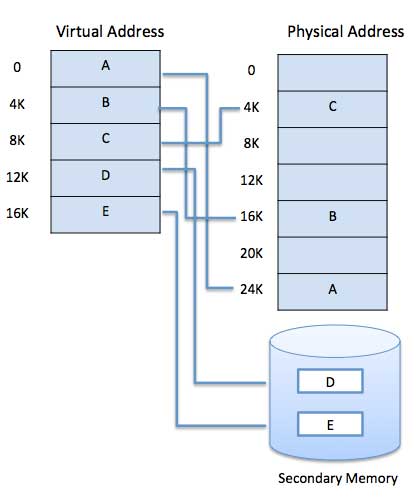
程序在运行时,OS把程序以page的形式,分页按需装入内存,注意,他不是连续装入的,有时候先装入这一块,有时候先装入那一块,甚至有一些呢虽然也在Virtual Memory里面,但是并不在RAM的物理地址中,有可能因为执行优先级低,放进了Secondary Memory (如上图)。
我们可以看到在这里,一个process的memory layout被大卸八块分别存储在实际的物理地址里。
Page Replacement Algorithm(*)
Page replacement algorithms are the techniques using which an Operating System decides which memory pages to swap out, write to disk when a page of memory needs to be allocated. 我们可以通过 Pages swap algorithm 来调度process需要的memory space
First In First Out (FIFO) algorithm
Easy to implement, keep a list, replace pages from the tail and add new pages at the head.
Optimal Page algorithm
Replace the page that will not be used for the longest period of time. Use the time when a page is to be used.
Least Recently Used (LRU) algorithm
Page which has not been used for the longest time in main memory is the one which will be selected for replacement.